

There’s a moment every camper knows.
The sun goes down, the campsite gets quieter, you’ve had your dinner, and you crawl into your sleeping bag feeling fairly pleased with yourself.
Then, sometime around 2am, you wake up thinking:
“Why am I absolutely freezing?”
If that sounds familiar, the sleeping bag’s temperature rating might have something to do with it.
Choosing a sleeping bag based on temperature isn't simply about picking the lowest number you can find. There’s a little more to it, but once you understand what those numbers mean, choosing the right bag becomes much easier.
So, let’s have a proper look.
What is a sleeping bag temperature rating?
A temperature rating gives you an idea of the conditions a sleeping bag is designed to handle.
You’ll usually see temperatures listed alongside the product specifications. These figures help you understand whether a sleeping bag is better suited to warmer summer nights, cooler spring and autumn evenings, or colder conditions.
But here’s the important bit:
A temperature rating isn't a guarantee that you personally will feel warm at that exact temperature.
Everyone sleeps differently.
Some people are naturally warm sleepers. Others can feel chilly even when everyone else seems perfectly comfortable. Your clothing, sleeping mat, tent, the weather and even how tired you are can all affect how warm you feel.
Think of the rating as a useful guide rather than an absolute promise.
Why do sleeping bags have different temperature ratings?
Because outdoor temperatures can change dramatically.
A sunny afternoon at a campsite might feel wonderfully warm, but once the sun disappears, the temperature can drop quickly.
This is particularly true in the UK, where weather has a habit of doing whatever it likes.
You might set off in glorious sunshine and end the evening wrapped up beside your tent wondering where summer went.
That's why choosing a sleeping bag based on the lowest temperatures you're likely to encounter is a sensible place to start.
Comfort temperature vs lower temperature
When looking at sleeping bag specifications, you may come across different temperature figures.
The comfort temperature is particularly useful because it indicates a temperature range where an average person should be able to sleep comfortably without feeling cold.
The lower limit refers to a colder temperature at which an average sleeper may still be able to sleep without feeling excessively cold.
These figures shouldn't be treated as identical.
If you're choosing a sleeping bag for regular camping, the comfort rating is generally the more useful figure to pay attention to.
After all, the goal isn't simply to survive the night.
You want to sleep well.
What about the extreme temperature?
Some sleeping bags may also list an extreme temperature.
This is not a temperature you should use when deciding whether a sleeping bag is suitable for your camping trip.
It represents a much more severe situation and shouldn't be treated as a recommended sleeping temperature.
So, when you're comparing sleeping bags online, don't simply look for the lowest number and assume that means the warmest or best option.
Look at the full temperature information.
How does insulation affect warmth?
The insulation inside your sleeping bag is one of the biggest factors affecting how warm it feels.
A sleeping bag with more insulation will generally be better suited to cooler conditions than one designed primarily for warm summer nights.
Synthetic insulation, such as hollow fibre, is a popular choice for outdoor sleeping bags. It provides warmth while remaining practical for camping and outdoor use.
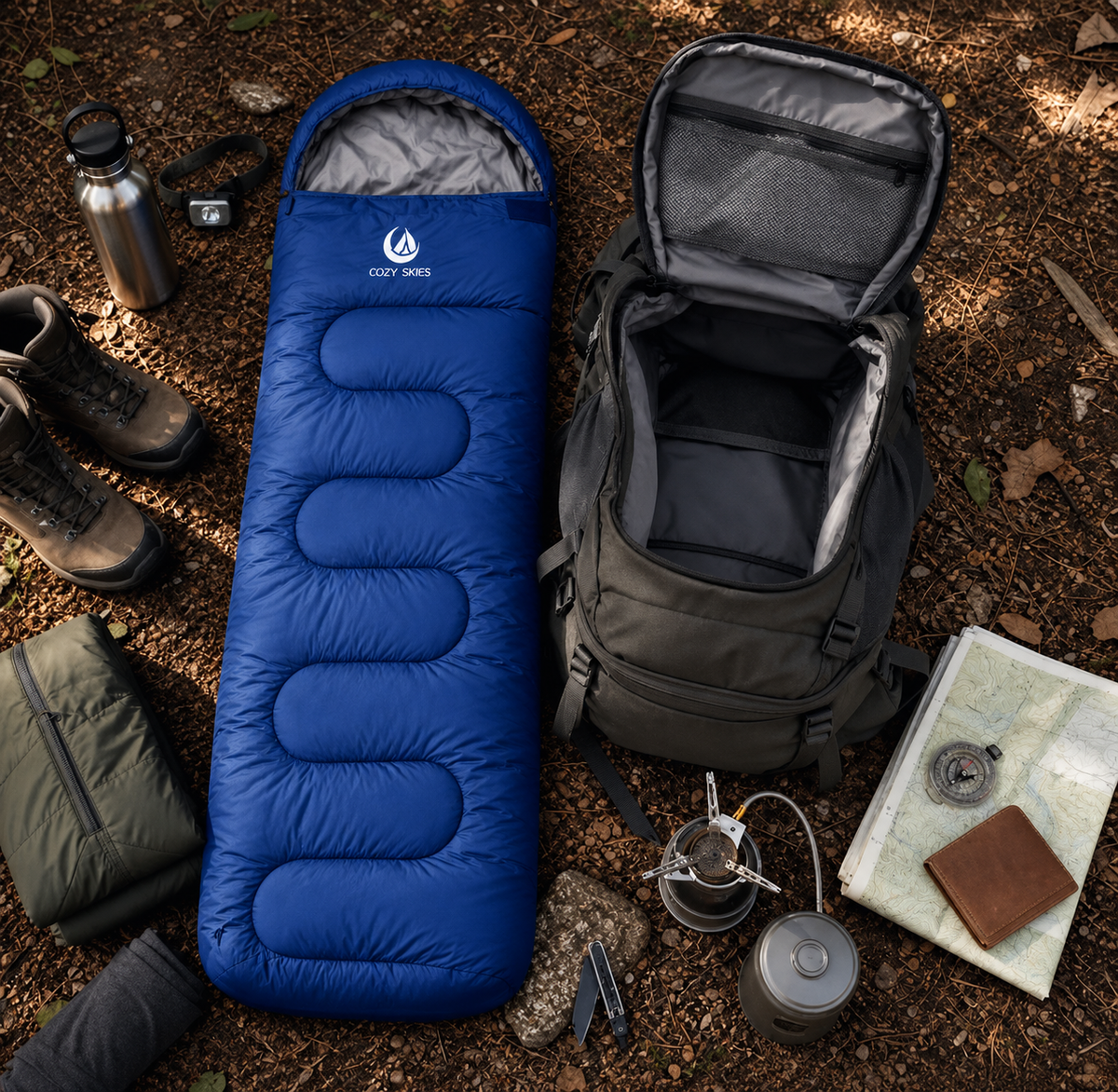
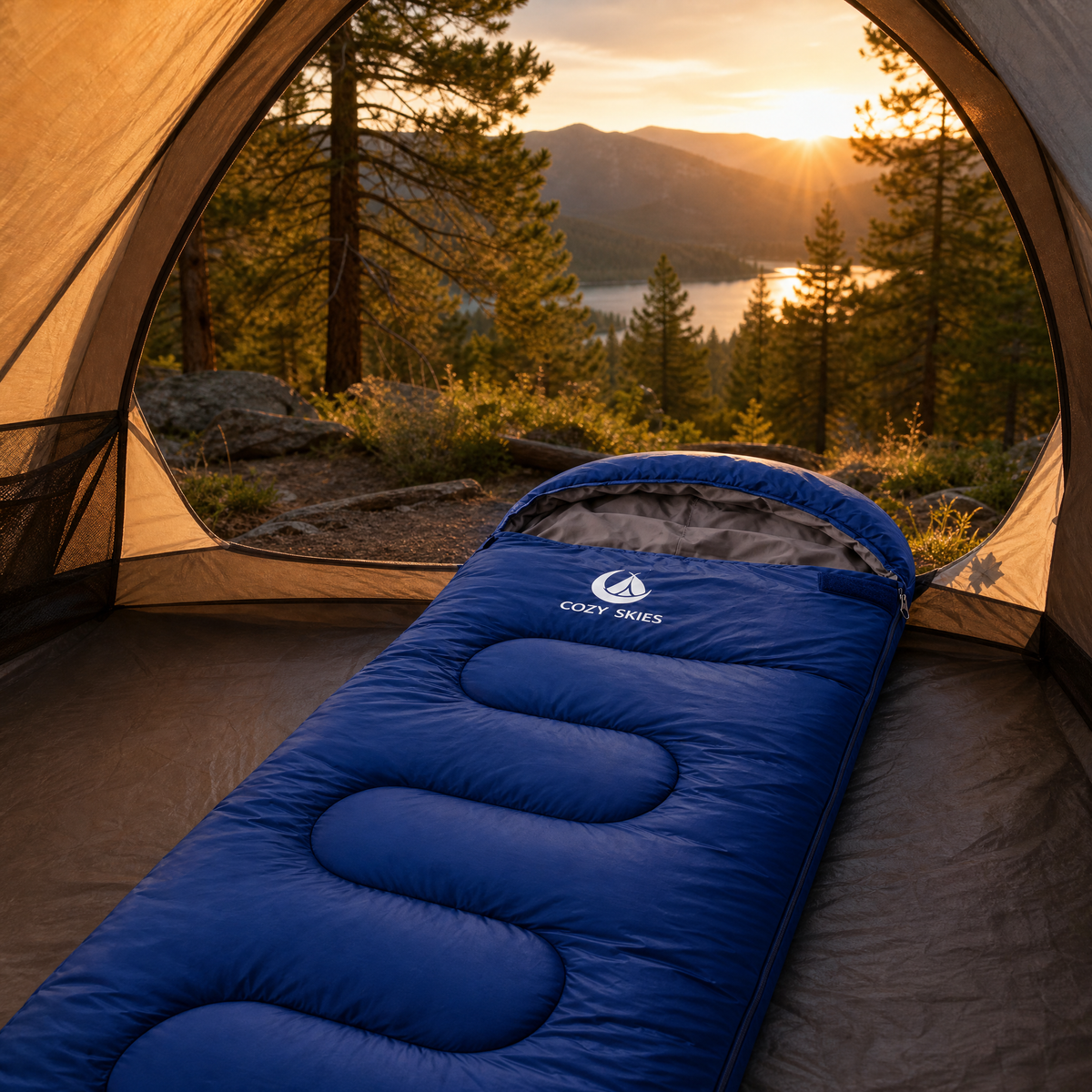
For example, the Cozy Skies sleeping bag uses 500gsm hollow fibre insulation and is designed for cooler nights, with an approximate temperature range of -5°C to 10°C.
That doesn't mean you'll automatically feel comfortable at -5°C in every situation.
Your sleeping mat, clothing, shelter and individual tolerance to cold all matter too.
Your sleeping mat matters more than you might think
Here's a little camping tip that can make a surprisingly big difference.
Your sleeping bag isn't working alone.
When you're lying down, your body compresses the insulation underneath you. That means the bottom of your sleeping bag isn't providing the same insulation as the sides and top.
A good sleeping mat helps create a layer between you and the cold ground.
So if you're camping on a chilly night and your sleeping bag feels warmer than expected but you're still cold underneath, your sleeping mat could be part of the problem.
Think of the two as a team.
Sleeping bag + sleeping mat = a much better night's sleep.
Your clothing makes a difference too
What you wear inside your sleeping bag can affect how comfortable you feel.
Dry, comfortable layers can help on cooler nights. A clean base layer can also make your sleeping bag feel much nicer after a long day outdoors.
Avoid climbing into your sleeping bag wearing damp clothes.
It might seem obvious, but after a wet day of hiking, it's tempting to simply get into bed and call it a night.
Don't.
Change into dry layers first. Your future self will thank you.
What temperature rating should you choose?
This depends on when and where you camp.
Summer camping
If you're mostly camping during warmer summer months, you may not need a heavily insulated sleeping bag.
A lighter option can be more comfortable when the weather is mild and can also be easier to carry.
Spring and autumn
This is where a warmer sleeping bag becomes particularly useful.
Even if daytime temperatures are pleasant, nights can become surprisingly cold.
If you're planning camping trips outside the height of summer, look for a sleeping bag designed for cooler conditions.
Wild camping
Wild camping requires a little more thought.
You're likely to be carrying your sleeping bag along with everything else you need, so you'll want a balance between warmth, weight and packability.
A warm sleeping bag that's incredibly bulky isn't always ideal when you're walking several miles with it on your back.
Camping in unpredictable weather
If you're camping in Britain, you already know the weather can be a bit unpredictable.
When conditions are uncertain, it's sensible to choose a sleeping bag with enough warmth for the cooler temperatures you might encounter.
Being slightly too warm is usually easier to manage than spending the night wishing you'd brought a thicker sleeping bag.
What does a -5°C to 10°C rating actually mean?
Let's use the Cozy Skies sleeping bag as an example.
Its approximate temperature range is -5°C to 10°C.
That doesn't mean:
“At -5°C, everyone will sleep perfectly comfortably.”
Instead, it means the sleeping bag has been designed with cooler conditions in mind within that general range.
Your experience can still vary depending on:
- Your clothing
- Your sleeping mat
- Your tent or shelter
- Wind and moisture
- Your individual cold tolerance
- Whether the bag is being used in appropriate conditions
This is why temperature ratings should always be considered alongside the rest of your camping setup.
Don't forget the season
A sleeping bag isn't necessarily limited to one season.
The important question is what temperatures are you realistically going to encounter?
If you're only planning summer camping trips, a very warm sleeping bag might feel excessive.
But if you enjoy spring and autumn adventures, a more insulated sleeping bag can give you greater flexibility.
For people who enjoy camping throughout the year, it may even make sense to have different sleeping bags for different conditions.
There isn't a prize for owning just one.
A simple way to choose
If all these numbers are beginning to feel like a lot, don't worry.
Here's a simple approach:
1. Think about the coldest conditions you'll encounter.
Don't base your decision purely on the warmest daytime temperature.
2. Look at the comfort rating first.
This is more useful for understanding everyday sleeping comfort.
3. Consider your sleeping habits.
If you naturally feel cold at night, you may want to choose a warmer option.
4. Think about your sleeping mat.
A good sleeping bag needs a suitable sleeping surface underneath it.
5. Consider how you'll travel.
For backpacking, weight and packed size matter more. For car camping, you have more freedom to prioritise warmth and space.
The bottom line
Sleeping bag temperature ratings might look confusing at first, but they're really there to help you make a better choice.
Don't simply look for the lowest temperature.
Instead, think about where you're going, when you're going, how you sleep and what the rest of your camping setup looks like.
A good sleeping bag should give you confidence when the temperature drops and the campsite goes quiet.
Because after a long day outdoors, you deserve to climb into your sleeping bag, settle down beneath the stars and actually get some proper sleep.
And in the morning?
You want to wake up feeling ready for whatever comes next.
Sleep well. Explore further.

Leave a comment
This site is protected by hCaptcha and the hCaptcha Privacy Policy and Terms of Service apply.